Biodegradable plastic materials, processing limits and composting claims
a[data-rs-seo-link]{text-decoration:underline!important;color:#1a56db!important;cursor:pointer!important;}a[data-rs-seo-link]{text-decoration:underline!important;color:#1a56db!important;cursor:pointer!important;}
What biodegradable plastic actually means
Biodegradable plastic is not a single resin family, and it is not a disposal guarantee. The term refers to plastics designed to be broken down by microorganisms under defined conditions. The rate and result depend on polymer chemistry, temperature, moisture, oxygen, time and the receiving environment. For processors and packaging buyers, the key question is not only whether a resin is biodegradable, but whether the finished article can be processed reliably, labeled accurately and collected through a suitable end-of-life system. A compostable cup, a soil-biodegradable agricultural film and a biobased but non-biodegradable bottle are different technical and regulatory cases. ISO 17088:2021, the U.S. EPA and the European Commission all treat compostability and biodegradability as condition-specific claims rather than universal outcomes. (iso.org)
This distinction matters in plastic processing because a sustainability claim can affect the resin family, drying requirement, melt temperature, additive package, labeling language and waste-management route. A biodegradable plastic that runs well in extrusion may still be the wrong specification if it contaminates a local recycling stream or if nearby composting facilities do not accept the item.
Biodegradable, biobased and compostable are different claims
The common mistake is to use “biodegradable,” “biobased” and “compostable” as interchangeable terms. They are not. A plastic may be made from renewable feedstock and still not biodegrade. Another plastic may be fossil-based and biodegradable. Compostability is narrower: it requires biodegradation under composting conditions and must also address disintegration, compost quality and limits on harmful residues.
| Term | What it means | What it does not automatically mean | Processing and labeling implication |
|---|---|---|---|
| Biobased plastic | Made partly or fully from biological feedstock such as sugar, starch or plant oils. | It is not automatically biodegradable or compostable. | Claims should specify biobased content and should not imply compostability unless separately verified. |
| Biodegradable plastic | Designed to be converted by microorganisms under specified conditions. | It does not mean the item will quickly disappear in soil, landfill, rivers or the ocean. | Claims should state the environment and time frame supported by testing. |
| Compostable plastic | A subset of biodegradable plastic intended to break down in a composting process without harming compost quality. | It is not automatically accepted by every municipal or commercial composter. | The finished product, not just the resin, needs suitable certification and disposal instructions. |
| Oxo-degradable plastic | Conventional plastic with additives intended to promote fragmentation. | It is not equivalent to proven biodegradation or compostability. | The European Commission has warned that oxo-degradable plastics fail to deliver proven environmental benefit and can harm recycling. |
The Federal Trade Commission’s Green Guides also emphasize that environmental marketing claims need competent and reliable evidence. For compostable claims, marketers should be able to show that the item will become usable compost safely and in about the same time as the materials with which it is composted. (ftc.gov)
Common biodegradable plastic families used in processing
Biodegradable plastics remain a small share of the total plastics market, but capacity is expanding. European Bioplastics and nova-Institute market data reported global bioplastics production capacity of about 2.31 million tonnes in 2025 and projected about 4.69 million tonnes by 2030, while bioplastics still represented less than one percent of total global plastics production. Those figures refer to capacity rather than guaranteed output, but they explain why more packaging converters are evaluating these resins. (european-bioplastics.org)
PLA, or polylactic acid, is widely used in thermoformed packaging, rigid containers, fibers and some film applications. It can offer clarity and stiffness, but it is moisture-sensitive before processing and has lower heat resistance than many conventional packaging plastics unless it is modified, crystallized or blended.
PBAT, or polybutylene adipate terephthalate, is flexible and is often used in compostable film blends, bags and coatings. It is commonly blended with starch, PLA or other polymers to balance toughness, sealability and biodegradation behavior.
PHA, or polyhydroxyalkanoate, is a family of microbially produced polyesters. Some PHA grades are promoted for broader biodegradation environments, but processability, cost and grade availability vary significantly, so converters should validate each supplier’s data against the intended process.
PBS, or polybutylene succinate, can be used in films, injection molded items and blends where flexibility and heat resistance are needed. As with PLA and PBAT, the final compound and article design influence certification outcomes.
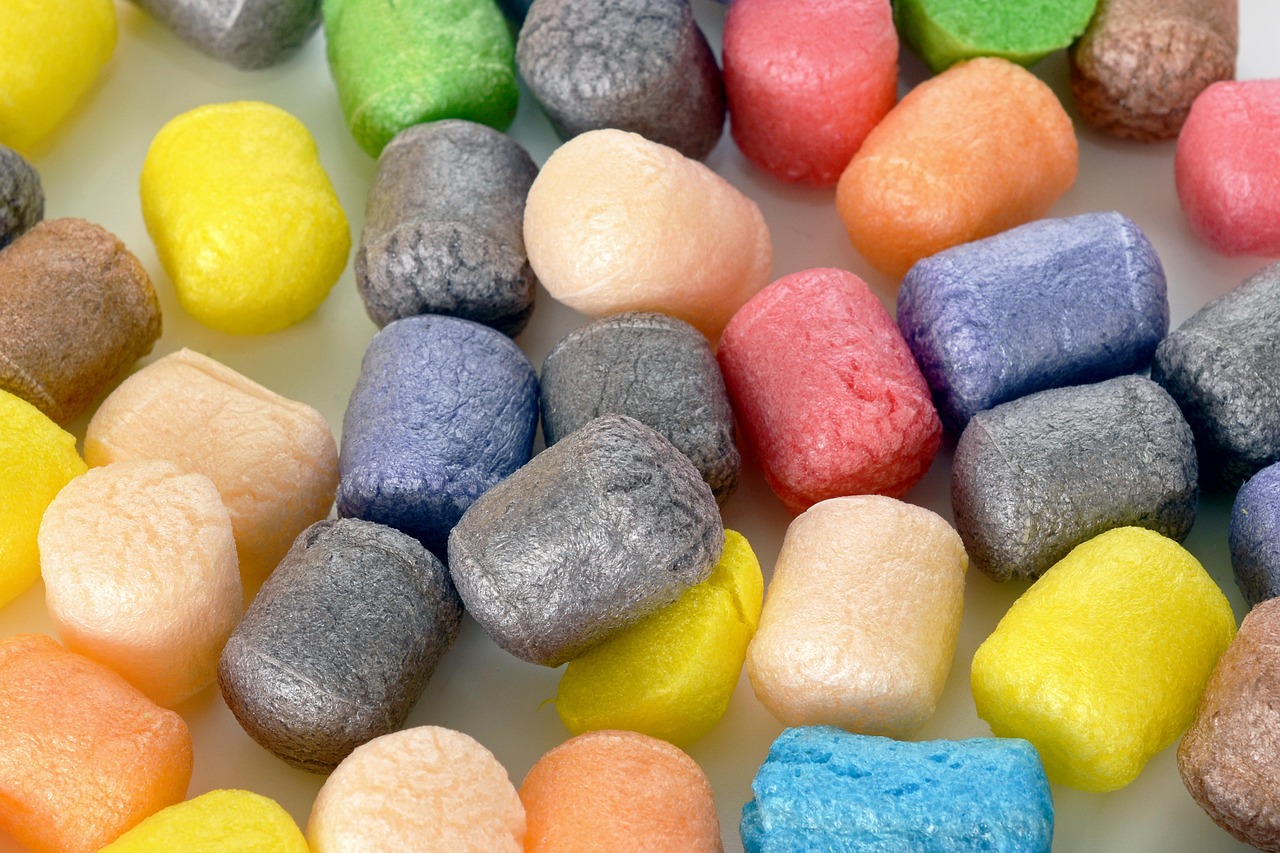
Starch blends are used in flexible bags, loose-fill packaging and other short-life products. They can reduce fossil carbon content and support compostability in suitable formulations, but they may be more sensitive to moisture and storage conditions than conventional polyolefins.
Processing limits that should be checked before scale-up
Most biodegradable plastic processing problems are not caused by the sustainability goal itself. They usually arise when these polymers are treated as direct drop-in replacements for PE, PP or PET without validating drying, melt stability and downstream performance.
- Drying matters. PLA, PHA, PBS and several biodegradable blends can lose molecular weight if processed with excess moisture. Resin drying targets should come from the material supplier and should be verified during trials.
- Thermal history must be controlled. High melt temperature, long residence time and aggressive shear can discolor or degrade sensitive biodegradable polymers. Purging plans are important when changing from conventional polymers to compostable grades.
- Tooling and cooling may need adjustment. Cycle time, mold temperature, crystallization behavior and part ejection can differ from standard commodity plastics.
- Heat resistance should be tested in the final article. A resin data sheet does not prove performance in a hot-fill cup, microwaveable tray or warehouse storage environment.
- Additives affect certification. Colorants, fillers, inks, adhesives, barrier coatings and processing aids can change whether the finished package meets compostability requirements.
- Film properties depend on blends. Compostable film often relies on multi-component blends to achieve puncture resistance, elongation, seal strength and conversion speed.
For processors, the safer approach is to test the finished article under real conversion and use conditions, not only the base resin. A material certified in pellet form may still require finished-product review when thickness, pigments, laminations or labels change.
Standards and claims shape market acceptance
Compostability standards are designed to make claims measurable. ISO 17088:2021 covers plastics and products suitable for organic recycling and addresses disintegration during composting, ultimate aerobic biodegradation, effects on compost and control of constituents. The standard also states that it does not provide requirements for biodegradability of plastics that end up in the environment as litter and is not intended for small household composting installations. (iso.org)
In the United States, ASTM D6400 is the key specification for labeling plastics designed to be aerobically composted in municipal or industrial facilities. It is relevant for packaging, bags and similar plastic products where compostability is claimed. ASTM D6868 is commonly referenced for end items that include plastic coatings or additives on paper or other compostable substrates. (store.astm.org)
For buyers, the practical issue is that compliance with a standard is not the same as local acceptance. A certified compostable package may still be rejected by a composting facility if the operator cannot process that item, cannot distinguish it from conventional plastic, or does not accept compostable packaging at all. The U.S. EPA notes that composting feedstocks accepted by facilities vary and should be free of contaminants, including non-compostable packaging. (epa.gov) See also: Buying Guides.
| Claim to review | Evidence to request | Risk if ignored |
|---|---|---|
| Biodegradable | Test method, environment, time frame and finished-item scope. | Vague claim may be misleading and may not match actual disposal conditions. |
| Industrial compostable | Certification to a relevant standard and confirmation of local facility acceptance. | Item may be landfilled or sorted out as contamination. |
| Home compostable | Separate home-compost evidence; industrial compostability alone is not enough. | Consumers may place items in backyard compost where they persist. |
| Recyclable and compostable | Clear pathway priority and local collection instructions. | Mixed instructions can contaminate both recycling and organics streams. |
Where biodegradable plastic makes the most practical sense
Biodegradable plastic works best when the application is short-lived, likely to be contaminated with food or organic matter, and connected to an organics collection system that accepts the item. Examples can include certified compostable foodservice items, produce stickers designed for composting systems, organic waste collection bags, certain paper coatings and selected agricultural products where soil-biodegradation standards apply.
It is harder to justify when a durable reusable product, a lightweight mono-material recyclable package or a well-established refill model would deliver a better result. For example, switching a clean PET bottle into a compostable polymer may reduce compatibility with existing bottle recycling without creating a reliable composting route. In that case, the environmental claim becomes weaker even if the resin itself is biodegradable under a test condition.
The European Commission’s policy framework makes a similar point: biodegradable and compostable plastics should be used only where they provide genuine environmental value and should not be presented as a solution to littering. The framework also emphasizes clear labeling, sustainable sourcing for biobased plastics and careful use of biodegradable claims. (eur-lex.europa.eu)
End-of-life planning should lead the material choice
The global waste context explains why the topic attracts attention. The OECD’s Global Plastics Outlook reported that only 9% of plastic waste was ultimately recycled, while 19% was incinerated and almost 50% went to sanitary landfills after recycling losses were considered. Biodegradable plastic does not automatically solve those system limits, but it can help in targeted cases where conventional recycling is unlikely and organic waste processing is available. (oecd.org)
Three end-of-life questions should be answered before a specification is approved. First, will the product be collected with food scraps or other organic material? Second, does the receiving facility accept this exact product category and certification? Third, will consumers and waste handlers understand the label well enough to put it in the right bin?
If the answer is no, a compostable or biodegradable claim may create more confusion than value. Landfill conditions are not the same as controlled composting. In mechanical recycling, many compostable plastics are contaminants unless a dedicated stream exists. In open environments, biodegradation can be slow, incomplete or highly variable. The design goal should be a verified route, not hope that the material will disappear after disposal.
A practical checklist for processors and packaging buyers
- Define the primary goal: lower fossil carbon, industrial compostability, food-waste diversion, soil biodegradation or another measurable outcome.
- Match the claim to the market: ASTM D6400, ISO 17088, EN 13432, ASTM D6868 or another relevant specification may apply depending on product type and region.
- Confirm whether the resin, compound or finished article is certified. Finished article thickness, printing and adhesives can matter.
- Run drying and melt-stability trials before commercial production.
- Test the real package for heat resistance, shelf life, sealing, drop performance, migration requirements and storage conditions.
- Ask local composters or waste-management partners whether the product category is accepted.
- Use clear labels that distinguish compostable items from recyclable plastics.
- Avoid broad phrases such as “eco-friendly” or unqualified “biodegradable” unless the claim is specific, supported and useful to the buyer.
The strongest biodegradable plastic projects begin with the waste route and then work backward to material selection, processing trials and user instructions. That approach reduces the risk of greenwashing and improves the chance that the package performs both on the production line and at end of life.
Frequently asked questions
Is biodegradable plastic always made from plants?
No. Biobased and biodegradable are separate attributes. Some biobased plastics, such as bio-based versions of conventional PE, may not be biodegradable. Some biodegradable plastics can include fossil-derived content. Buyers should ask for both feedstock information and biodegradation or compostability evidence.
Can biodegradable plastic go in home compost?
Only if the product is specifically suitable for home composting and local guidance allows it. Industrial compostability standards usually assume controlled conditions that are different from backyard compost piles.
Can biodegradable plastic be recycled?
It depends on the polymer and the local system. Biobased drop-in plastics may be compatible with existing recycling streams if they have the same chemistry as conventional plastics. Compostable plastics such as many PLA or starch blends are usually kept out of standard recycling unless a dedicated collection and processing route exists.
Does biodegradable plastic solve plastic pollution?
No. It can reduce impacts in selected applications with verified collection and treatment, but it is not a license to litter and it does not replace reduction, reuse, better recycling and improved waste management.
Which standard should a packaging buyer request?
For U.S. industrial compostable plastic packaging, ASTM D6400 is commonly requested. For plastic-coated paper or similar substrates, ASTM D6868 may be relevant. ISO 17088 and EN 13432 are often discussed in international and European contexts. The correct standard depends on the product, market and disposal route.